MENU
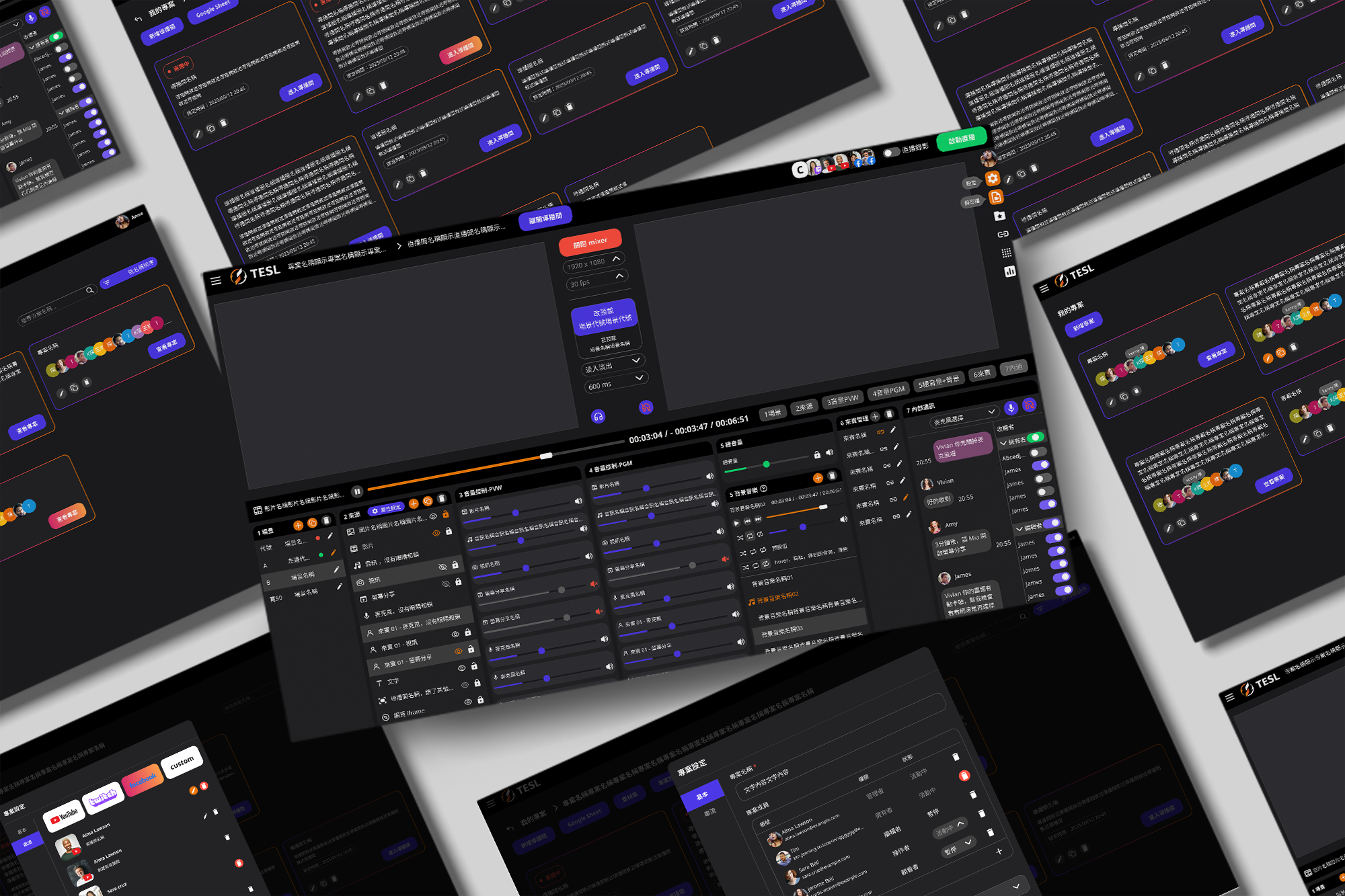
TESL is a web-based broadcasting platform that makes professional live streaming as easy as a video call. It solves the common pain points of traditional streaming—such as blurry video, audio delay, and complex software setups.
• Zero Friction: No software installation needed. Guests simply click a link to join and share their camera or screen.
• Professional Quality: The platform merges multi-source signals in the cloud, delivering TV-station quality output to Facebook, YouTube, and Twitch.
As the platform approached its critical acceptance phase, we faced a major bottleneck: Latency and Synchronization.
When merging signals from different user sources (cameras, screens, mics), the audio and video were often out of sync due to complex factors like browser limits, internet speeds, and hardware differences. These were "ambiguous technical debts"—we knew the experience wasn't perfect, but the root causes were unclear, spanning across frontend, backend, and streaming protocols.
As the Project Lead, I realized we couldn't just "fix the bug"—we needed to define the problem first. I took a structured approach to manage this ambiguity:
• Defining the Unknown: I consolidated these vague technical issues into a dedicated "Epic" (a large project goal). I re-evaluated the User Stories to clarify the business impact: Is this critical for launch? What are the consequences if we don't fix it?
• Bridging Business & Tech: I facilitated intensive alignment sessions with the Stakeholders, Marketing, and Engineering teams. We prioritized issues into "Must-fix," "Can-wait," and "Won't-fix" categories. We made strategic trade-offs to let go of minor issues, ensuring our limited resources were focused strictly on high-impact problems.
• Research-First Approach (Spikes): For the complex sync issue, I assigned engineers to conduct "Spikes" (technical research tasks). Instead of coding blindly, we designed data-driven experiments together. I actively tracked the results and dynamically adjusted our development roadmap based on real-time findings.
By visualizing all issues and solutions on our Kanban board, the entire team gained clear visibility on project feasibility.
Solved the Sync Issue: Through our experiments, we identified a new technical approach that significantly reduced latency and resolved the multi-source synchronization problem.
A Competitive Edge: This improvement wasn't just a bug fix—it became a powerful selling point. The marketing team leveraged this "ultra-low latency" achievement to prove our product was superior to competitors, directly boosting our sales pitch and market positioning.